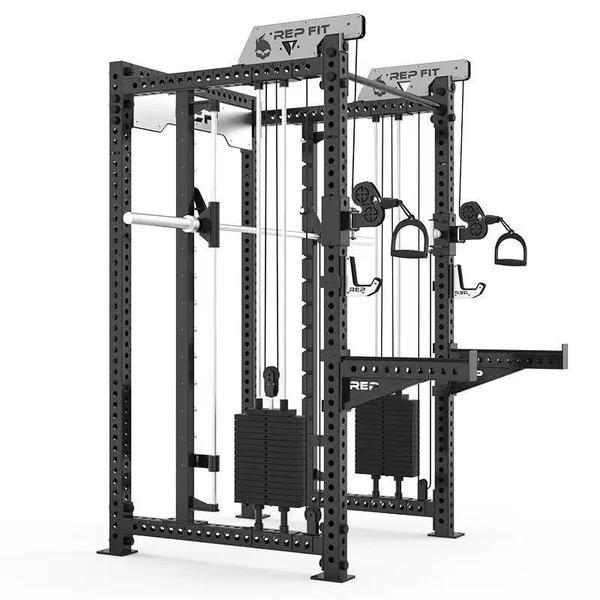
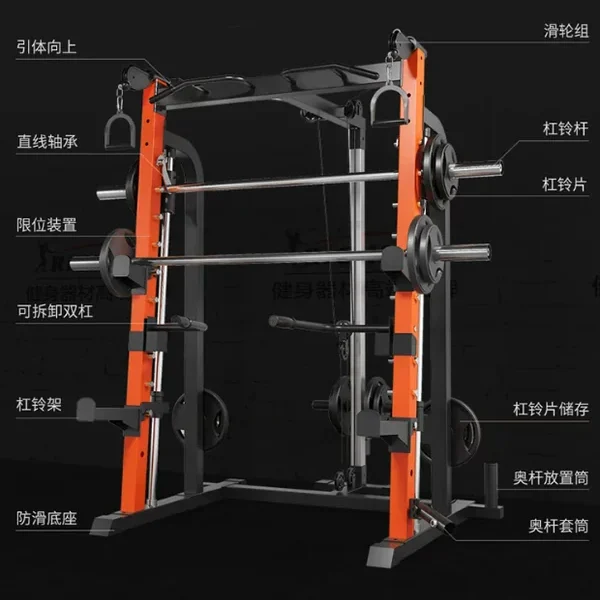
Quick answer: choose a Smith machine if you train alone, want built-in safety, or need a compact all-in-one station. Choose a squat rack if you want free bar movement, maximum functional carryover, and already have a spotter or safety bars.
Training Benefits Compared
| Smith Machine | Squat Rack | |
|---|---|---|
| Bar path | Fixed (typically 7° angle) | Free — full control |
| Stabilizer recruitment | Lower | Higher |
| Load safety without a spotter | Excellent (stops catch the bar) | Good with spotter arms; risky without |
| Training to failure | Safe and easy | Needs spotter or pins |
| Exercise variety | High (squat, bench, press, rows, hip thrusts, calf raises) | High (squat, bench, OHP, pull-ups with a bar) |
| Muscle activation | Target muscles slightly less | Full chain, more balance work |
Space & Budget
- Smith machine: one footprint replaces a rack, a bench station and often adds a pull-up bar and storage. Our MF-SM50 is 72″ tall — it fits standard 8 ft ceilings — with an integrated plate storage.
- Squat rack: requires the rack footprint plus bar and plate storage. You will usually add a separate bench and pull-up bar.
- Budget: a commercial-grade Smith machine and a commercial power rack are comparable; compact Smiths are often cheaper than a rack + bench + bar + plates bundle.
Who Should Choose What
- Home users who train alone: Smith machine. The safety stops are the difference between training to failure and not.
- Athletes and powerlifters: squat rack. Free bar movement is the sport.
- Commercial gyms: both. A Smith machine is the most-used strength station in most facilities; a power rack zone serves the barbell crowd.
- Rehab and beginners: Smith machine — the fixed path and light counterbalanced bar (about 15 lb effective) make learning safer.
Our Recommendations
- Commercial Smith Machine MF-SM100 — 1,000 lb capacity for 24/7 gyms
- Compact Smith Machine MF-SM50 — 800 lb capacity, home-ceiling friendly
- Browse the full Smith lineup